Scoot Henderson stats is one of the most exciting young talents in professional basketball today. Drafted third overall in the 2023 NBA Draft, Henderson has quickly made a name for himself with his electrifying playmaking ability, athleticism, and potential as a future star in the NBA. This article will explore Scoot Henderson’s statistics throughout his basketball journey—from his time in the NBA G League to his performances with the Portland Trail Blazers in the NBA. We will break down his numbers, what they mean, and how they reflect his growth as a player.
Early Professional Career: G League Ignite Stats
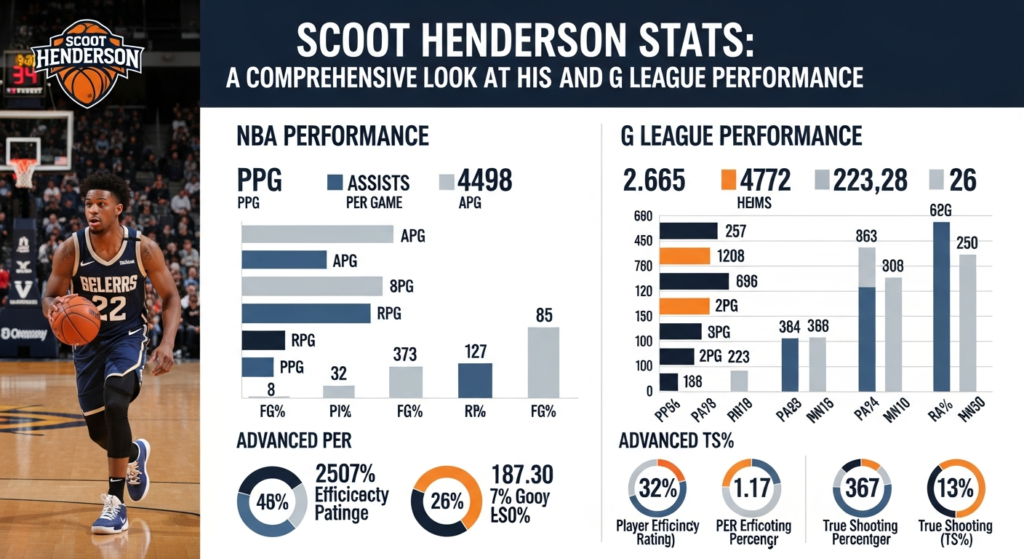
Before entering the NBA, Scoot Henderson played for G League Ignite, a developmental team designed to prepare elite prospects for the NBA. In his G League season, he showcased his versatility as a guard. Henderson averaged 16.5 points per game, showing his ability to score at a high volume. Along with his scoring, he contributed 5.3 rebounds and 6.8 assists per game, demonstrating his all-around impact on the court. His shooting percentages included a 42.9% field goal percentage and 27.5% from three-point range.
Those numbers are significant because they reflect Henderson’s ability to do more than just score. He not only put the ball in the hoop, but he also helped facilitate offense for his teammates and worked to grab rebounds despite his position as a guard. Though his three-point shooting was an area for improvement, his overall game showed promise, particularly his ball-handling and vision.
NBA Career Beginnings with the Trail Blazers
After being selected third overall by the Portland Trail Blazers in the 2023 NBA Draft, Scoot Henderson transitioned from the G League to the NBA. In his NBA career, as of the end of the 2024‑25 season, Henderson has played 128 regular season games, accumulating valuable experience at the highest level of competition. Across those games, he has averaged 13.3 points per game, 5.2 assists per game, and 3.1 rebounds per game.
These statistics reveal Henderson’s role as a primary scoring option and a facilitator for his team. His assist numbers highlight his court vision and ability to involve teammates in the offense. Meanwhile, his rebounding numbers show that he remains active and involved in play even after shots go up.
2024–25 Season Statistics
The 2024–25 season was particularly important for Henderson’s development. In that year alone, Henderson played 66 games and averaged 12.7 points, 5.1 assists, and 3.0 rebounds per game. He also shot 41.9% from the field and 35.4% from three‑point range, which represented improvements in his offensive efficiency.
A near 36% three-point percentage is notable for a young guard, as it shows that Henderson has worked on extending his shooting range—an area that many scouts saw as a weakness coming out of the G League. At the same time, his assist numbers continued to demonstrate his vision and leadership on the court.
Shooting Efficiency and Offensive Efficiency
Examining Henderson’s shooting splits provides further insight into his offensive game. In the 2024–25 season, his shooting percentages show 41.9% from the field, which indicates solid scoring efficiency for a guard who often creates his own shot. Additionally, his 35.4% three-point shooting points to growth beyond the arc, a critical skill for perimeter players in the modern NBA.
However, advanced analyses from basketball discussions and fan‑driven stat breakdowns suggest that Henderson’s true shooting percentage (TS%) has room for improvement. Efficiency metrics like TS% take into account field goals, three‑pointers, and free throws to evaluate a player’s scoring efficiency more completely. While there are debates in fan forums about his accuracy based on these metrics, the NBA statistics provide an official overview of his performance.
Assists and Playmaking
Scoot Henderson’s ability to run an offense is one of his strongest attributes. Averaging over 5 assists per game in both the 2024–25 season and through his NBA career shows that he can create scoring opportunities for his teammates at a high level. His court vision and quick decision‑making set him apart from many young players in the league.
Notably, Henderson has also had standout moments in his playmaking that highlight his potential. For example, he has recorded games with high assist totals that place him among top young facilitators. Even though official league pages do not list every individual game, fan‑generated statistics reflect notable achievements in assists that speak to his impact on the court.
Rebounding and Defensive Contributions
While Scoot Henderson’s primary roles are scoring and playmaking, he also contributes on the glass and defensively. Averaging around 3 rebounds per game is solid for a guard, especially one who spends much of his energy initiating offense. His defensive stats, which include steals and occasional blocks, show that he is engaged on both ends of the court.
Defensive statistics such as steals per game help provide perspective on a player’s effort and anticipation ability. While the official NBA numbers indicate moderate totals in defensive stats, Henderson’s quick hands and athleticism often make him a disruptive presence on defense.
Comparison Between G League and NBA
Comparing Scoot Henderson’s G League numbers with his NBA stats shows how he has adapted to higher competition. In the G League, his scoring and assist numbers were higher, partly because of his larger role in that developing league. However, in the NBA, his statistics still remain impressive given the elevated competition and different team roles.
A transition from high usage in the G League to a more structured role in the NBA is common for young players. Henderson’s ability to maintain solid statistics across both leagues shows resilience and adaptability, qualities that bode well for his long‑term prospects.
Injury Impact on Stats
Injuries have affected some of Henderson’s playing time, particularly during the 2025‑26 season. A torn hamstring suffered during an offseason workout sidelined him and prevented him from playing that season’s games. While this doesn’t directly affect past statistics, it may impact his future contributions and rhythm when he returns.
Before the injury, Henderson was working toward improving his statistics and expanding his role with the Trail Blazers. His recovery progress and eventual return could influence his stats positively if he comes back fully healthy and continues to develop his game.
Conclusion: What Henderson’s Stats Tell Us
Scoot Henderson’s statistics tell the story of a young guard with great potential and a solid foundation as a professional basketball player. His scoring has remained consistent in the NBA, his assists reflect his playmaking strength, and his shot selection and efficiency show signs of improvement. Comparing his time in the G League to the NBA highlights his growth and adaptation.
FAQs
What are Scoot Henderson’s career averages in the NBA?
As of the end of the 2024–25 season, Scoot Henderson averages approximately 13.3 points, 5.2 assists, and 3.1 rebounds per game in the NBA.
How did Scoot Henderson perform in the G League?
Playing for the G League Ignite, Henderson averaged 16.5 points, 6.8 assists, and 5.3 rebounds per game, showing his scoring and playmaking ability.
What is Scoot Henderson’s three-point shooting percentage?
In the 2024–25 NBA season, Henderson improved his three-point shooting to around 35.4%, showing growth in his perimeter game.
Has Scoot Henderson faced any injuries affecting his stats?
Yes, a hamstring injury during the 2025–26 offseason impacted his playing time, but his prior stats reflect his strong performance before the injury.
What do Scoot Henderson’s stats reveal about his playing style?
His stats indicate he is a versatile guard capable of scoring, facilitating offense, and contributing on rebounds and defense, with room to grow in efficiency and consistency.