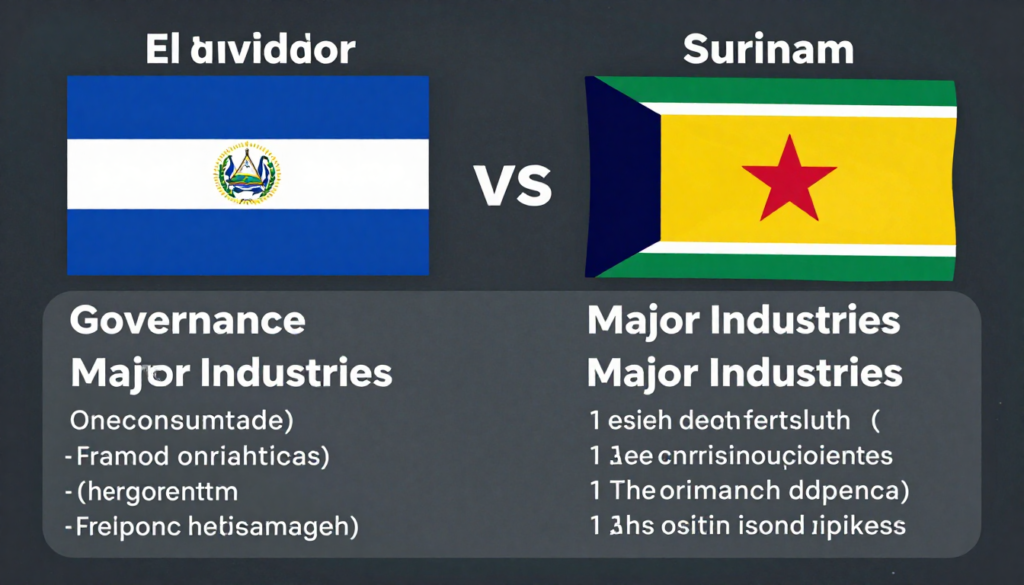
When discussing international football, culture, or geography, the matchup between El Salvador vs. Surinam sparks curiosity. These two nations, located in different regions of the Americas, offer rich histories, diverse cultures, and passionate sporting traditions. While El Salvador lies in Central America, Surinam (officially known as Suriname) is situated on the northeastern coast of South America.
In this article, we explore El Salvador vs. Surinam across multiple dimensions — geography, history, culture, economy, and football — providing a detailed comparison of these fascinating countries.
Geographic Overview
El Salvador is the smallest and most densely populated country in Central America. It shares borders with Guatemala and Honduras and has a coastline along the Pacific Ocean. Known as the “Land of Volcanoes,” the country features dramatic landscapes, volcanic mountains, and scenic beaches.
Surinam, on the other hand, is one of the smallest countries in South America but significantly larger than El Salvador in land area. It borders Guyana, Brazil, and French Guiana, with a coastline on the Atlantic Ocean. Surinam is heavily covered in tropical rainforest, making it one of the most forested nations in the world.
The contrast in geography is striking: El Salvador’s compact volcanic terrain versus Surinam’s expansive rainforests and river systems.
Population and Demographics
El Salvador has a population of over six million people, making it densely populated relative to its size. The majority of Salvadorans are of Mestizo descent, blending Indigenous and European ancestry.
Surinam has a much smaller population — around 600,000 people. What makes Surinam unique is its ethnic diversity. The population includes people of Indian, African, Javanese, Chinese, Indigenous, and European descent. This multicultural identity plays a major role in shaping Surinamese society.
While El Salvador is more homogenous culturally, Surinam stands out for its ethnic and linguistic diversity.
Language and Culture
Spanish is the official language of El Salvador, and Catholicism has historically been the dominant religion. Salvadoran culture is strongly influenced by Indigenous Pipil traditions and Spanish colonial heritage. Festivals, music, and traditional foods like pupusas are central to national identity.
In Surinam, Dutch is the official language — making it the only Dutch-speaking country in South America. However, several other languages are widely spoken, including Sranan Tongo, Hindi, and Javanese. Religiously, Surinam is highly diverse, with Christianity, Hinduism, and Islam all practiced widely.
Culturally, El Salvador reflects traditional Central American roots, while Surinam showcases a rare blend of Caribbean, Asian, African, and European influences.
Historical Background
El Salvador’s history includes Spanish colonization, independence in 1821, and a devastating civil war from 1980 to 1992. The peace accords marked a new era of democratic governance and reform.
Surinam was colonized by the Dutch and gained independence in 1975. The country experienced political instability and military rule during the 1980s before transitioning toward democratic governance.
Both nations have experienced colonial influence and internal struggles, yet each has carved its own path toward modernization.
Economic Comparison
El Salvador’s economy is largely driven by services, manufacturing, agriculture, and remittances from citizens living abroad. The country made headlines in 2021 by adopting Bitcoin as legal tender, becoming the first nation to do so.
Surinam’s economy relies heavily on natural resources, particularly gold, oil, and bauxite. Mining and energy exports play a significant role in its GDP. However, Surinam has faced economic challenges, including inflation and debt crises in recent years.
In economic structure, El Salvador leans toward service-based activities, while Surinam depends more on resource extraction.
Football Rivalry: El Salvador vs. Surinam
One of the most exciting aspects of El Salvador vs. Surinam is football. El Salvador has a stronger football history overall. The El Salvador national football team has qualified for the FIFA World Cup twice (1970 and 1982) and regularly competes in CONCACAF tournaments.
Surinam’s team, the Suriname national football team, has historically had less international success. However, recent improvements and the inclusion of diaspora players have strengthened the squad significantly.
When these teams meet in competitions such as the CONCACAF Nations League or World Cup qualifiers, matches are competitive and energetic. El Salvador typically brings more tournament experience, while Surinam showcases technical flair influenced by Dutch football development systems.
Style of Play Comparison
El Salvador is traditionally known for its disciplined defensive approach and passionate home support. The team often relies on tactical organization and counterattacks.
Surinam, influenced by Dutch football philosophy, tends to emphasize technical skills, ball control, and attacking creativity. Many Surinamese players have trained or played in European leagues, contributing to a more possession-based style.
In a head-to-head matchup, the clash becomes one of tactical discipline versus technical fluidity.
Tourism and Natural Attractions
El Salvador offers surf-friendly Pacific beaches such as El Tunco and scenic volcano hikes like Santa Ana Volcano. The country has worked to improve safety and attract tourism in recent years.
Surinam is an eco-tourism paradise. With vast Amazonian rainforests, rivers, and wildlife reserves, it appeals to nature enthusiasts seeking adventure and biodiversity.
Travelers looking for beach culture and compact exploration may prefer El Salvador, while those interested in untouched rainforest experiences may gravitate toward Surinam.
Political Systems
El Salvador operates as a presidential republic. In recent years, the country has gained global attention due to strong anti-gang policies and economic reforms.
Surinam also functions as a democratic republic with a president as head of state. Its political landscape has experienced shifts but remains committed to democratic governance.
Both nations continue to navigate political reform and development in their own regional contexts.
Education and Development
El Salvador has made progress in literacy and infrastructure but still faces economic inequality challenges.
Surinam benefits from a relatively small population, which allows for broader access to education in urban areas. However, rural regions face development limitations due to geographic isolation.
Each country has opportunities for further growth through investment and social reform.
International Relations
El Salvador is part of Central American integration systems and maintains close ties with the United States.
Surinam is a member of Caribbean and South American organizations and maintains strong ties with the Netherlands due to historical connections.
Geographically and diplomatically, the two countries operate within different regional frameworks.
Conclusion
The comparison of El Salvador vs. Surinam highlights two unique nations shaped by distinct histories, cultures, and geographic landscapes. El Salvador stands out for its dense population, volcanic terrain, and established football tradition. Surinam distinguishes itself with vast rainforests, multicultural diversity, and growing football potential.
While their differences are significant, both countries share resilience, cultural pride, and ambition for growth. Whether comparing football squads or national identity, El Salvador vs. Surinam represents more than just a matchup — it symbolizes the diversity of the Americas.
FAQs
What is the main difference between El Salvador and Surinam?
The main difference lies in geography and culture. El Salvador is a small, densely populated Central American country, while Surinam is a sparsely populated, rainforest-rich South American nation with diverse ethnic groups.
Which country has a stronger football team, El Salvador or Surinam?
Historically, El Salvador has had more success, including two World Cup appearances. However, Surinam has improved significantly in recent years.
What language is spoken in El Salvador vs. Surinam?
Spanish is spoken in El Salvador, while Dutch is the official language of Surinam.
Is Surinam bigger than El Salvador?
Yes, Surinam is much larger in land area but has a significantly smaller population.
Are El Salvador and Surinam in the same football federation?
Yes, both compete under CONCACAF for international football tournaments despite Surinam being geographically in South America.